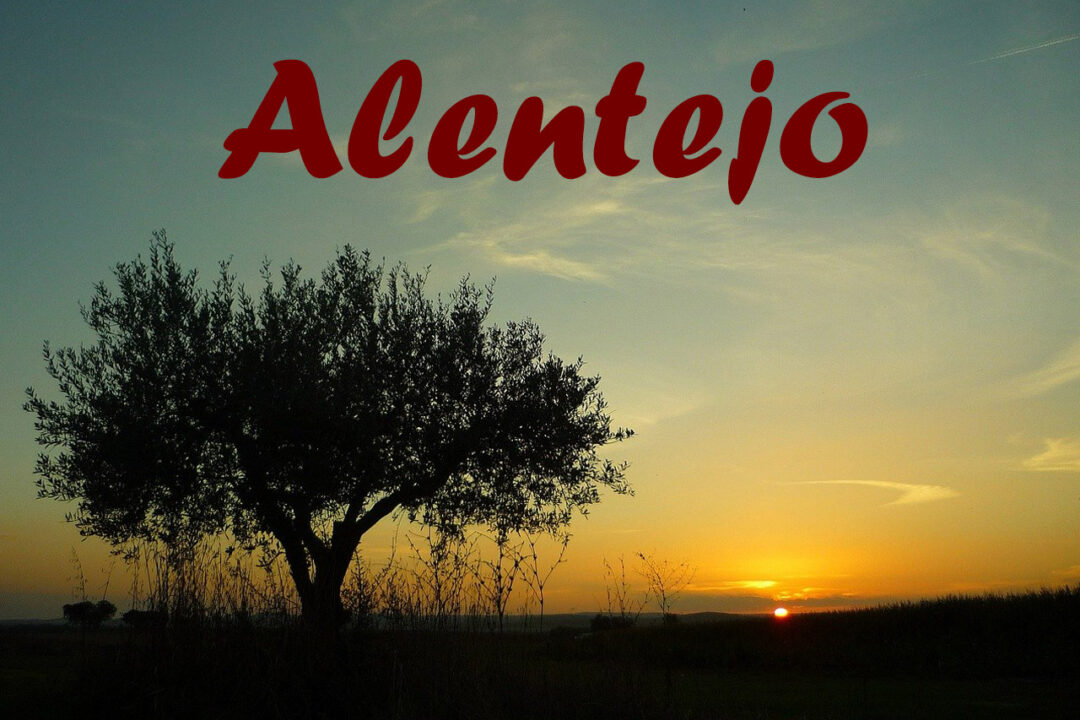
The Algarve may be Portugal’s top holiday destination, but for wine lovers, that is Alentejo, one of Portugal’s southern wine regions. Especially if you like the quiet life.
While the UNESCO World Heritage city of Evora has impressive 15th-century Manueline architecture that speaks of a golden age when royalty lived there, this impoverished agricultural region – one-third of Portugal – is today it’s least populated.
Location
The region is named for its position south of the Tejo river, which bisects Portugal, entering the ocean near Lisbon. Even the briefest of glances at a population density map of Portugal shows that this area of the country is only very sparsely populated, in stark contrast to the northern coastal areas around Oporto. The land here is used for the production of various cereal crops, and the cork for which Portugal is so famous. Whereas the cork plantations of the north are quite small, here, in Alentejo there is sufficient free space for the thick-barked trees to sprawl out all over the countryside.
Alentejo is one of the largest wine regions in the country, with a warm and dry climate and an excellent terroir, which has attracted many investments in the wine sector, making its wines one of the best Portuguese wines and has received many international recognitions.
Origin
Alentejo is one of the most beautiful regions of the country.
Its history is extensive, with traces of Phoenician civilization found in many places more than 3,000 years ago. Then the Celts, and especially the Romans, who left an important legacy through their writings, mosaics, teachings, cities and monuments. They mainly specialized in the main farming techniques, they started to engage in wine and viticulture in the region.
It is likely that Alentejo production also facilitated the first Roman exports of Portuguese wines. Roman influence was so crucial to the development of viticulture in Alentejo that today, two thousand years after the annexation of the area, signs of Roman civilization can still be found in everyday works, on commonly used tools such as pruning or clay pots, which was used to ferment must and later to store wine and is still used today.
After the Romans and Visigoths, the Arabs came to this land, before the reconquest. They built numerous castles and walls to protect the cities.
After the expulsion of the Moors from the Alentejo, royal power and religious orders encouraged winemaking. The population was obliged to cultivate the land with vines and after three, four or five years since planting, they were obliged to give a certain amount of their harvest. In 1221, D. Afonso Henriques, the first king of Portugal, determined that the grapes and wine produced would be owned by the Cathedral of Évora.
From that time until today, Alentejo has continued to grow, a growth based on agriculture, livestock, fisheries, industry (especially cork production) and, more recently, on tourism, presenting a wide range of quality for wine tourism.
Region
Alentejo is a vast and varied region. Only five percent of the land is planted with vines. One of the most exciting areas is right up in the north-east corner, around the city of Portalegre and over towards the Spanish border. This high mountain country has a much cooler climate than the rest of the Alentejo, and the potential to make more elegant wines.
The central Alentejo, wide, rolling country around the towns of Évora, Borba, Reguengos and Estremoz, is hotter and makes wines with a good balance of acidity.
Even further south, in the bakingly-hot country around Beja, winemakers are producing some excellent wines. Soils vary hugely, from granite and schist to chalk.
Between towns, you can drive for miles without seeing a soul, through the cork and olive groves, past sweet-scented lavender fields, golden wheat, maize, sunflowers, vines, and grazing livestock.
The prettiest and most pleasant time to visit is April or May, when everything is still green and aromatic, before the heat and drought of the summer months. Less than five percent of the Portuguese population lives in the Alentejo. Occasionally you catch sight of a whitewashed farmhouse atop a gentle hill, or ‘monte’. (You will meet the word ‘Monte’ on wine labels – it is used here to mean farmhouse or estate.) The Alentejo is famous for its beef, and for deliciously moist and flavorsome ham and pork from the black pigs that roam freely in the cork forests, feeding on acorns.

Source: Wine Tourism in Portugal
Soil and climate
The region has a gently undulating topography, which protects much of the land from the cooling effects of the Atlantic. This lends the land to the production of rich, easy-drinking red wines, as ripeness is easy to achieve in these conditions. However, there are some anomalies – the subregion of Portalegre is in the foothills of the mountains in the northeast of Alentejo, where the climate is considerably cooler.

Source: Wine Tourism in Portugal
A region of rolling plains, the Alentejo has a relatively smooth and flat landscape that stretches over almost a third of mainland Portugal.
The soils alternate between shale, clay, marble, granite and limestone, in an unusual diversity.
The climate is clearly Mediterranean, hot and dry, with a strong continental influence.
Alentejo is divided into eight sub-regions: Borba, Évora, Granja-Amareleja, Moura, Portalegre, Redondo, Reguengos and Vidigueira, grouped into three distinct groups.
Portalegre is the most original sub-region, with predominantly granitic soils, influenced by the freshness of the Serra de São Mamede. The landscape offers countless plots of old vines, planted on the steep slopes of the mountain, benefiting from a unique microclimate that gives freshness and complexity.
Borba, Évora, Redondo and Reguengos embody the Alentejo identity, a land of balance and harmony, in the right proportion between freshness and fruit, energy and softness.
The sub-regions of Granja-Amareleja, Moura and Vidigueira, in the south of the appellation, offer warmer and softer wines, with poor and drylands, where the vineyard suffers from the harsh climate and the poverty of the soils.
DOC
Alentejo has been a key center of Portugal’s wine renaissance over the past few decades. Portugal’s entry into the EU had brought long-overdue investment in vineyards and cellars. Modern technology – especially temperature control – has made it possible to make good, softer whites as well as rich reds.
Demarcated region in 1988, it is divided into eight sub-regions: Reguengos, Borba, Redondo, Vidigueira, Évora, Granja-Amareleja, Portalegre and Moura.

Source: Decanter
An increasing number of regional wines are labeled ‘Vinho Regional Alentejo’.
Besides the Alentejo Regional Wine, which is found all over the region, wine producers are spread across the 8 areas bearing a designation of origin (DOC), which allows for a diversity of choice anywhere in Alentejo.
- ALENTEJO PDO
(PDO – Protect Designation of Origin)
In order for a wine to be certified as Alentejo PDO it must have been made from grapes grown within one of the eight PDO sub-regions of the Alentejo.
Each sub-region has its own particular conditions for growing grapes, which confer its own unique character to the wines, owing to a terroir that has been explored since the time of the Romans.
Wines certified as Alentejo PDO can, alternatively, mention the name of the PDO sub-region that they come from.
- ALENTEJO PGI
(PGI – Protect Geographical Indication)
Wines certified as Alentejo PGI are made from grapes grown in the districts of Portalegre, Évora or Beja.
Wines from outside of the PDO sub-regions can only be certified as Alentejo PGI. However, a wine produced within a PDO area can choose to be certified as PGI, as these wines are allowed to use a greater number of grape varieties.
The decision to seek certification as Alentejo PGI transcends the question of geography. Instead, it is more closely tied to the issue of looser regulations and greater freedom to select grape varieties. Under this certification, non-native varieties can be blended with the traditional Alentejo ones. So it is not only those producers located outside the eight PDO sub-regions who seek out the PGI category. A great number of traditional producers are seeking this category as well.
Grapes
The most important white grape varieties in the region are the Arinto, Antão Vaz, Roupeiro, Fernão Pires and Perrum.
Regarding the red varieties, it stresses the importance of Aragonez, Trincadeira, Castelão, Alfrocheiro and Alicante Bouschet (French variety).

Source: Wine Tourism in Portugal
Wines
A wine-producing region with a long tradition, the Alentejo boasts wines that will surprise you for their excellence, aromas and colors as unique as the landscape and the cuisine.
This huge, sun-drenched area, covering much of the southern half of Portugal, has in recent years become an important source of big, ripe, fruity, easy-drinking reds that often dominate the wine lists of Lisbon restaurants.
The distinct characteristics of the soils according to the area (granite, limestone or schist), the long hours of exposure to the sun and a group of selected grape varieties enable high-quality production, combined with the ability to preserve the tradition of flavor, while innovating in the art of winemaking.
White wines are aromatic, fresh and balanced, while red wines are ruby or garnet colored, more intense, full-bodied.
Alentejo is a well-known, highly respected wine region in eastern Portugal. This hot, dry area is best known for its red wines, the best of which are sold under the and Alentejo DOC title. These wines are typically made from Aragonez (Tempranillo), Castelao, Trincadeira or a rich, ripe, jammy blend of the three. Although famously diverse in its portfolio of wine grapes, Alentejo has not been sluggish to adopt such globally popular varieties as Syrah and Cabernet Sauvignon. One of the most remarkable things about modern Alentejo winemaking is its ability to create a uniquely Alentejo wine style from quintessentially French grape varieties.
White wines from Alentejo DOC are generally aromatic, fresh and balanced, mild, slightly acid, and with aromas of tropical fruits. The reds are ruby or garnet colored, more intense, full-bodied, rich in tannins and with aromas of wild and red berries.
Summarizing, the Alentejo wines offer tremendous pleasure, be they white, rosé or red wine.
No Comments Found